
Other Teams
As he prepares to retire, Western Mustangs head coach Greg Marshall voices optimism about Canadian university sport amid growing financial strain

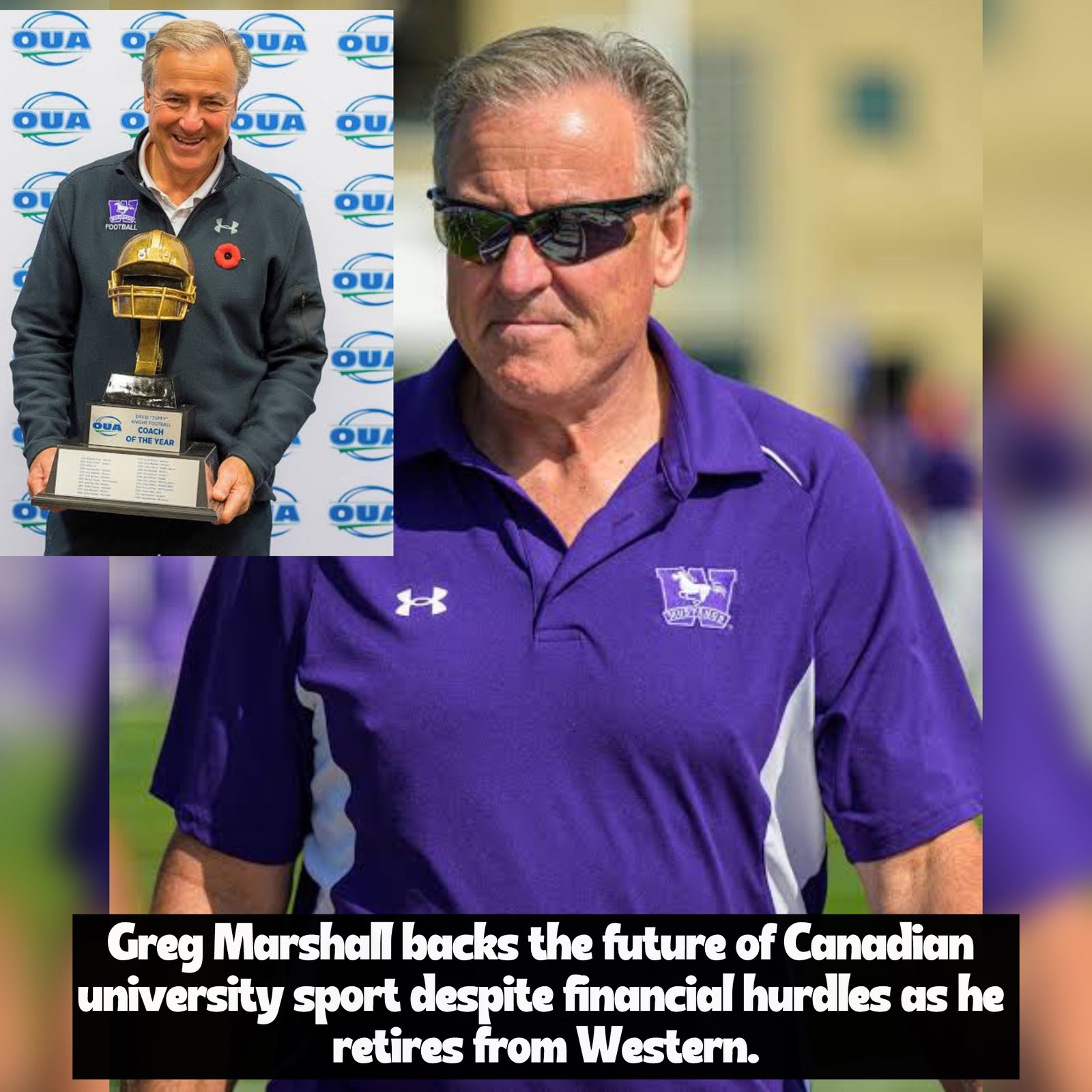
Greg Marshall may be stepping away from his role as head coach of the Western Mustangs, but retirement has not dulled his belief in Canadian university athletics.
At 66, Marshall remains confident that U Sports will weather the financial strain currently affecting post-secondary institutions nationwide. While funding pressures have intensified, he believes the challenges are temporary rather than terminal.
“I think we’ll come through this phase,” Marshall said. “A lot of the funding issues stem from changes to international student enrolment. That affects colleges and universities alike, and when budgets tighten, ancillary services like athletics are often the first to face cuts. We need to be creative and find solutions.”
The threat of athletic department reductions has grown in recent years, with McGill University announcing last month that it will discontinue 25 sports programs in 2026 due to sustainability concerns. Although football was spared, Marshall sees the loss of any varsity sport as damaging to campus life.
“Every sport offers a different competitive pathway,” he explained. “If we pride ourselves on delivering a strong student-athlete experience in football, why wouldn’t we want that same opportunity available to as many students as possible? Not every program needs equal funding, but limiting high-quality experiences to only a few sports ultimately diminishes what a university should be.”
McGill’s decision sparked concern that other schools could follow suit. Nearly half of Ontario’s universities have recently operated at a deficit, including Waterloo, Queen’s, Wilfrid Laurier, and Guelph. With institutions already cutting services elsewhere, athletics often becomes an easy target.
While football remains the flagship sport within U Sports, it is also the most expensive to operate. Simon Fraser University’s decision to eliminate its NCAA football program in 2023 demonstrated how financial and competitive pressures can converge. Though controversial at the time, the move may serve as a warning for struggling programs nationwide.
Western, long considered a national powerhouse, is in a stronger position than most. Still, Marshall notes that continued success depends heavily on fundraising and donor support.
“Fundraising has always been a major part of my job,” he said. “To compete at the highest level, you need resources. Laval raised the standard across the country — investing in coaching, facilities, and athletic awards. If you want to compete with programs like that, you have to be willing to match that commitment.”
Costs are likely to increase further as external changes loom. The CFL’s planned shift to smaller field dimensions in 2027 has prompted U Sports to consult stakeholders on whether to adopt similar changes. While not mandatory, such adjustments could help schools that share facilities with professional teams.
Marshall supports many of the CFL’s proposed rule changes but recognizes the financial burden they could place on universities.
“Moving goalposts isn’t cheap,” he said. “Many schools will want to wait and see how things play out before committing to those expenses. Shortening the field from 110 to 100 yards doesn’t make much sense to me — it won’t dramatically change the game, but it will cost money, especially since many fields have permanent markings.”
Marshall’s coaching career spans more than four decades, beginning in 1984, with a brief stint in the CFL with the Hamilton Tiger-Cats. As a former Hec Crighton Trophy winner himself, he has watched the university game evolve significantly.
“The athletes today are simply better prepared,” he said. “Training, coaching, and development at the youth and high school levels have all advanced. Players are bigger, faster, stronger, and more knowledgeable. The game is far more complex now than it was 40 years ago.”
With that evolution comes higher expectations. NCAA athletes can now profit from name, image, and likeness opportunities, and the transfer portal has reshaped player movement. While U Sports has not gone as far, recent adjustments to transfer rules reflect the changing landscape.
Despite generational shifts, Marshall sees familiar qualities in today’s players.
“They’ve changed, but not as much as people think,” he said. “They’re still motivated — academically and athletically. They want to succeed.”
What he values most, however, are the relationships built over a lifetime in the sport.
“Coaching has always been about watching young people grow,” Marshall reflected. “Seeing them arrive at 17 or 18, nervous and unsure, then mature into confident adults — fathers, professionals, leaders — that’s incredibly rewarding.”
For Marshall, that transformation underscores the true value of university sport. Despite financial pressures and structural change, he remains convinced that Canadian university athletics has a strong and enduring future.
-

 Sports4 weeks ago
Quinn, Jack Hughes fire back at Toronto press post-Gold Medal win
-

 Blog1 month ago
New news on Marie-Philip Poulin creates uncertainty ahead of quarterfinal
-

 Other Teams1 month ago
Police comment on fatal accident that claimed the lives of three junior hockey players
-

 Other Teams4 months ago
CFL Expansion: 3 New Cities That Should Get a Team and reason why
-

 Other Teams4 months ago
Saskatchewan Roughriders quarterback Trevor Harris breaks silence and deliver his swift decision on his CFL future
-

 Sports6 days ago
These CFL stadiums are crying out for renovations, fans won’t like who lands at No.3.
-

 Blog1 year ago
ULTIMA ORA: Riesco ancora a mangiare 3 pasti al giorno anche senza la Juve. Il direttore sportivo della Juventus FC Cristiano Giuntoli ha lasciato la Juve senza parole annunciando ufficialmente la data del suo addio a causa…
-

 Sports1 month ago
Harsh wake-up call for driver involved in Humboldt Broncos tragedy